Beyond the Ballon d'Or: What the Data Reveals
From Barcelona to the NWSL, Opta's Power Rankings reveal why the strength of competition matters when assessing the world's best.
A third Ballon d'Or for Putellas.
But how do we measure the world's best?
Alexia Putellas has claimed a third Women's Ballon d'Or, but the limited representation of NWSL players in the final rankings raises an intriguing question: are we comparing the world's best footballers on a level playing field? Opta's global Power Rankings offer a different perspective.
Alexia Putellas is once again at the summit of women's football.
The Spanish midfielder's third Ballon d'Or adds another remarkable achievement to an extraordinary career, cementing her place among the defining players of her generation.
But beyond the celebrations, this year's awards raise a broader question about how we recognise the world's best footballers — and whether the strength of the competitions they play in receives enough consideration.

La Reina reigns again:
The numbers behind her crown
Alexia Putellas' third Ballon d'Or crowns an extraordinary season in which she captained Barcelona to a historic quadruple, winning Liga F, the UEFA Women's Champions League, the Copa de la Reina and the Supercopa de España. Before moving to London City Lionesses in July 2026, she finished her iconic career with the Catalan club with 232 goals across 508 appearances.
From goals and assists to creating chances and orchestrating play, Opta's data reveals the remarkable individual influence behind her award-winning campaign.

21 goals. 13 assists.
Across all competitions in 2025-26, Putellas combined goalscoring with exceptional creativity, directly contributing to 34 goals in 2,926 minutes.
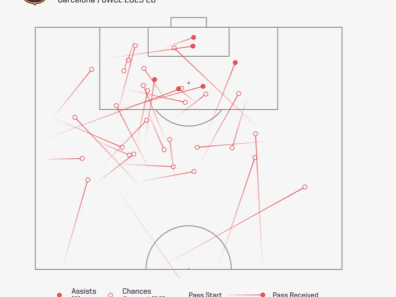
36 chances created.
Putellas created 36 chances in the Women's Champions League, the joint-most in the competition, while also providing six assists.
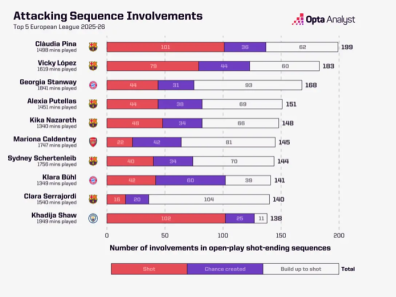
151 attacking sequences.
Only three players across Europe's top five domestic leagues were involved in more open-play shot-ending sequences than Putellas, highlighting her influence beyond goals and assists.
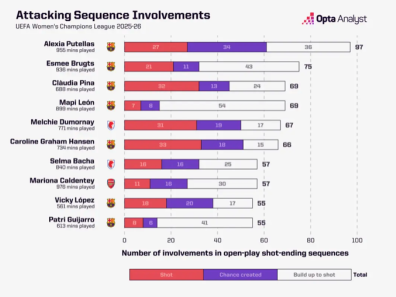
97 UWCL sequences.
No player was involved in more open-play shot-ending sequences in the 2025-26 Women's Champions League, underlining her defining role in Barcelona's European success.
The Ballon d'Or's European dominance: Where are the NWSL stars?
While Putellas' third Ballon d'Or celebrates individual excellence, the wider shortlist raises questions about the global recognition of women's football.
Of the 30 nominees for the 2026 award, just six represented clubs outside Europe during the relevant period. Five had played in the NWSL, including Manaka Matsukubo, who subsequently joined Chelsea, while Scarlett Camberos represented Mexico's Club América.
It's a striking imbalance given the strength of women's football in North America. The NWSL also follows a different calendar, running from spring to autumn, meaning its players are at a different stage of their domestic season when the Ballon d'Or is awarded.
But does the shortlist reflect the relative strength of the world's leading leagues? Or do differences in competition, calendar and visibility influence how individual performances are recognised?
Beyond Europe: What Opta's Power Rankings reveal
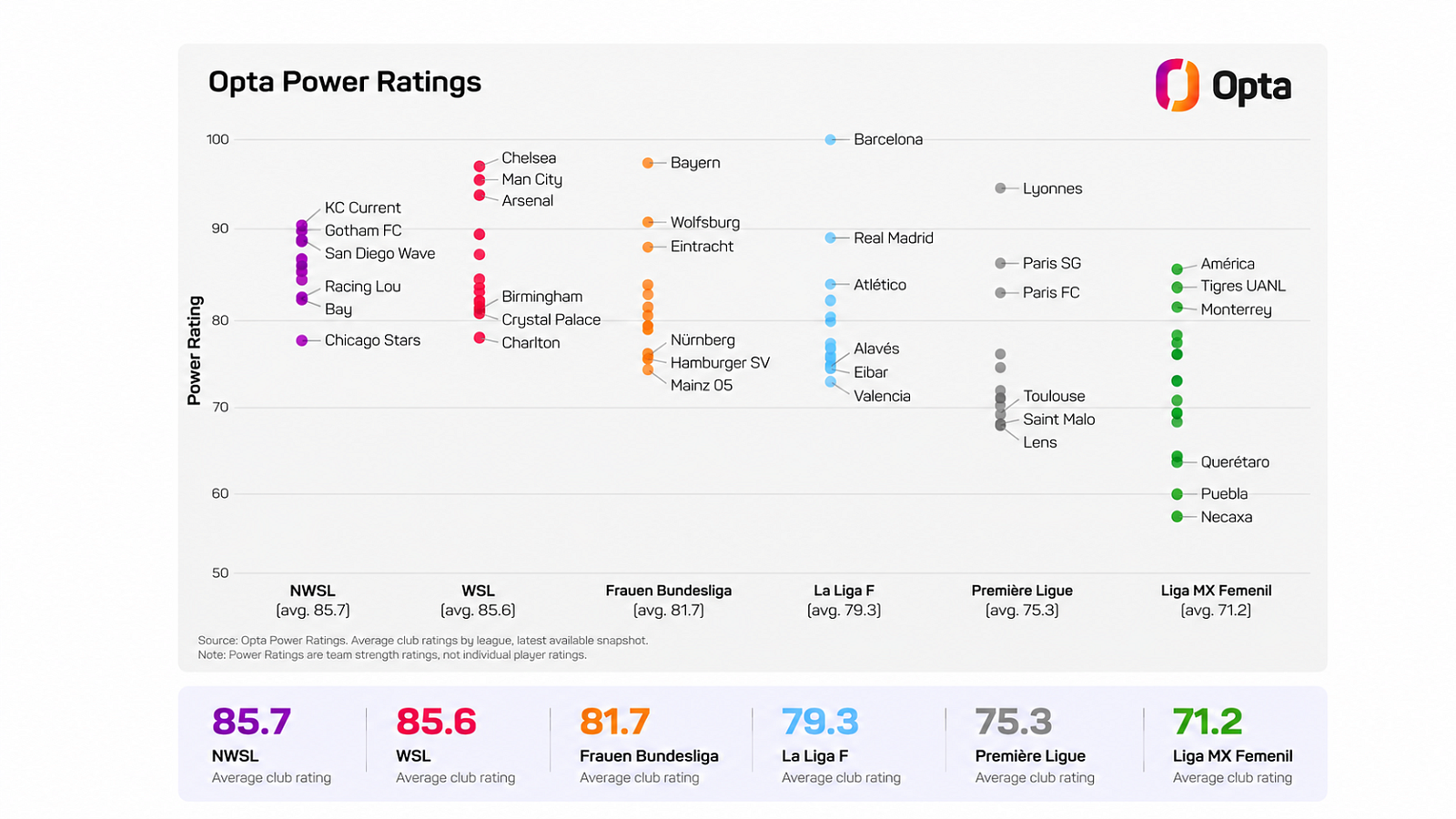
Opta's global Power Rankings offer a different perspective on the strength of women's football worldwide.
Covering more than 2,500 clubs, the rankings provide a consistent measure of team strength across leagues and continents.
And the results might surprise you.
The NWSL has the highest average club Power Rating of the six leagues compared, at 85.7, narrowly ahead of the Women's Super League at 85.6.
While Barcelona sets the global benchmark with a rating of 100, the NWSL's strength lies in its competitive depth. Its clubs are more closely grouped, with fewer extremes between the strongest and weakest teams.
The result is a league where players regularly face strong domestic opposition, even if its clubs and players receive less attention in European-dominated awards discussions.
Power Ratings measure team strength, not individual brilliance. But they provide important context when comparing performances across different competitions.
If the NWSL is competing at this level, why are so few of its players represented among the world's most celebrated footballers?
One global game. Unmatched insight. Trusted data.
Opta works with some of the biggest competitions in women's football, combining decades of historical data with advanced performance metrics to tell the stories behind the world's game.
Through our global Power Rankings and predictive models, we're turning data into debate, giving fans new ways to explore title races, team strength and individual performances.
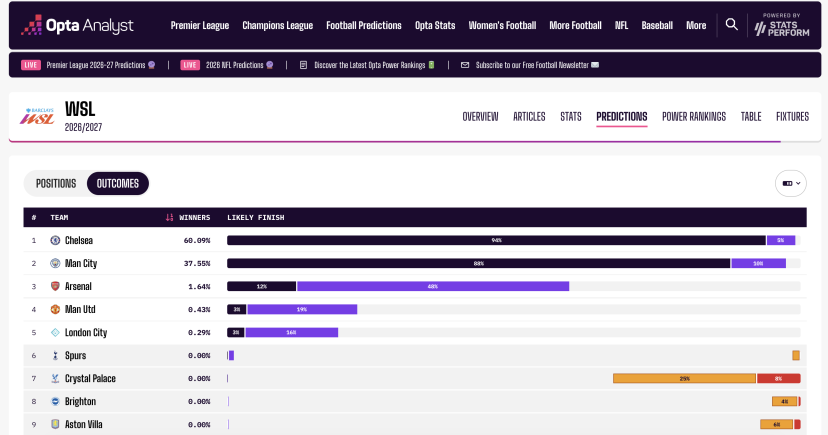
Our predictions and probabilities now cover Europe's five leading domestic leagues, the NWSL and the UEFA Women's Champions League, with dedicated Stats Hubs on Opta Analyst making these insights accessible to fans, journalists and broadcasters.
It's a combination of global coverage, historical depth and predictive storytelling that sets Opta apart from other data providers.
The road to 2027: A global stage for the world's best
The 2027 FIFA Women's World Cup in Brazil will bring together the world's leading players from different leagues, continents and competitive environments.
And Opta will be ready to tell their stories in greater depth than ever before.
Combining decades of historical World Cup data with advanced performance metrics, global Power Rankings and Opta Vision, we'll unlock new insights into player movement, space, pressure and the moments that shape matches.
As women's football continues to grow, so too does the opportunity to understand and celebrate its greatest players through richer, more meaningful storytelling.
The Ballon d'Or celebrates the world's best players.
Opta provides the data to understand what makes them the best.

Turn women's football data into stories that matter
Want to bring deeper insights and more engaging storytelling to your competition, platform or audience?
From global Power Rankings and predictive probabilities to advanced player metrics and Opta Vision, our Data Insights team turns trusted Opta data into stories that engage and inspire fans.
With the road to the 2027 FIFA Women's World Cup already underway, make sure you're ready for the biggest year in women's football yet.
Find out more from our team