Why sports graphics need real data behind them
AI-generated sports content has become a genuine part of the toolkit for many organisations.
Tools like ChatGPT can write match summaries, pull together player narratives and produce visuals quickly - and for a lot of use cases, that speed is genuinely valuable.
But there is a specific limitation worth understanding, particularly if you are producing data-driven sports graphics at scale.
To test this in practice, we asked ChatGPT to generate a touch heatmap for Declan Rice from Arsenal's pivotal match against Burnley on May 18th. It searched for the underlying data, could not locate it reliably, and after around two and a half minutes of processing, generated a heatmap based on approximated values. The graphic looked reasonable. Compared to the actual Opta data, it was not accurate.
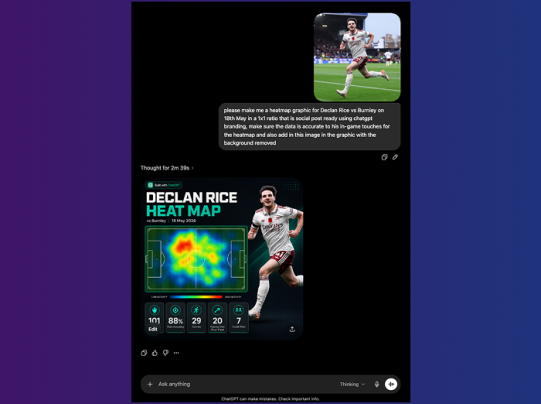
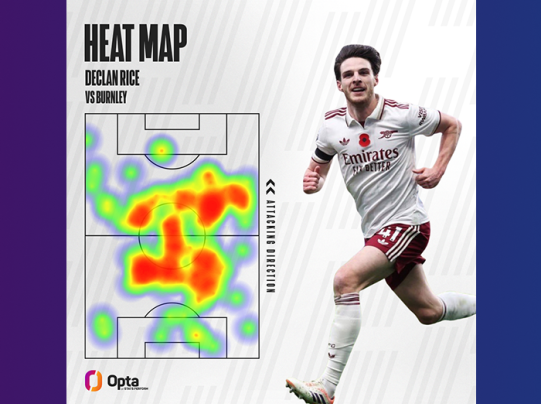
This is not a criticism of the tool – it's an honest description of what language models can and cannot do. ChatGPT does not have licensed access to proprietary match data. When the exact data is not available, it fills the gap as best it can. For a lot of tasks, that is fine. For sports graphics where accuracy is the whole point, it creates a real problem. That’s where Opta Graphics comes in.
Why data accuracy matters for sports graphics
For leagues, broadcasters, media outlets and sportsbooks, a graphic that looks right but uses incorrect data is not a neutral outcome. Audiences who follow sport closely notice. The credibility of the content - and the brand behind it - depends on what is underneath the visual.
That is the foundation Opta Graphics is built on.
What Opta Graphics does
The data powering every graphic comes from Opta's proprietary collection across sports - structured, verified and always current. When a graphic shows Rice's touches, it shows his actual touches.
With our newest features in Opta Graphics, you now have the ability to turn our trusted data into high-quality branded content at speed and scale, without a design team or production pipeline sitting in the middle.
Here’s what makes Opta Graphics crucial for your team:
Data you can trust. The platform draws on live, always-current Opta data across sports. Whether you are producing content during a match or the following morning, the data is accurate and up to date.
Self-serve template creation. Content, editorial and social teams can build, adapt and publish graphics independently - no design bottleneck, no waiting on production. Reusable templates mean you build once and deploy many times.
No rendering infrastructure required. No-code workflows mean there is no technical setup to configure before you start publishing.
Multiple brand kits. Organisations managing more than one brand, competition or partner can create and manage separate brand kits in one place, with every graphic staying on-brand regardless of who creates it.
Multi-platform outputs. From one platform, the same data-driven graphic adapts to social, broadcast, digital, in-venue and sportsbook formats.
Commercial activations at scale. This tool is built to support higher volumes of commercial activity - including temporary sponsor activations and mid-season campaigns - without the production overhead that previously made those difficult to deliver.
But the point is not the tool alone. It is the data which powers it.
The question for any organisation producing sports graphics is not which tool generated the visual - it is whether the data underneath it is accurate enough to publish.
Opta Graphics built to answer that question clearly and reliably, every time.
To find out how we can start empowering your teams with Opta Graphics, request a demo below.