From Data to Decisions: What We Heard at Opta Forum 2026
Five key insights and perspectives that industry leaders shared at Opta Forum 2026.
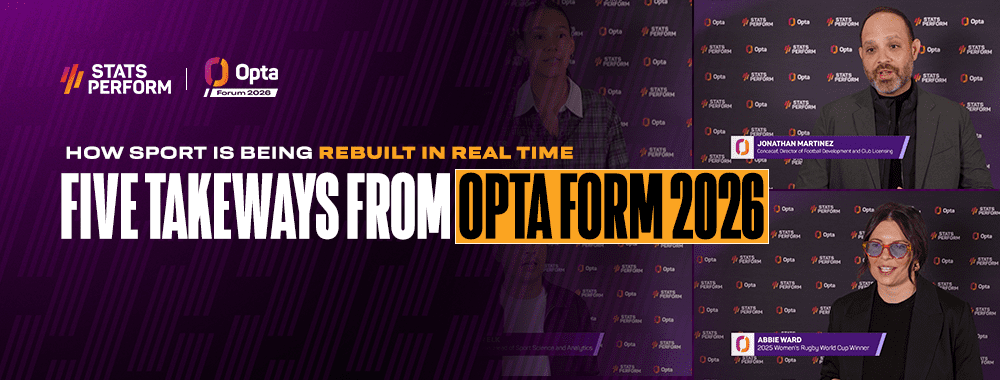
The Opta Forum 2026 brought together leaders from across sport, media, federations and technology, all navigating the same fundamental shift.
Sport is no longer just played and broadcast – it’s measured, interpreted and experienced in real time.
Across two days of discussion, one theme stood out: data is no longer supporting the industry – it’s shaping it.
Here are five key takeaways that emerged from the conversations at this year’s Forum.
1. Trust in data: the new foundation of sport
As the volume of data continues to grow, so too does the need for trust – not just in accuracy, but in interpretation.
Sports organisations are rapidly expanding their ability to collect, enrich and use data across performance analysis, fan engagement and commercial strategy. But access alone is no longer enough.
The value lies in confidence: in the data itself, and in how it is applied.
This was a recurring theme across both performance and commercial discussions. Whether in coaching, recruitment or fan engagement, confidence in the data layer is now critical.
And that trust extends beyond accuracy. As data becomes more embedded across workflows, it must also be:
- understandable
- consistent
- actionable
Because ultimately, if data cannot be trusted, it cannot drive decisions.
Key takeaway
Trust is no longer just a technical requirement – it’s a strategic differentiator.
2. Data driving decisions: from insight to action
The industry has moved beyond dashboards and retrospective analysis.
Data is now embedded directly into the fabric of sport:
- informing recruitment and player valuation
- shaping match preparation and tactical planning
- driving content creation and storytelling
- underpinning commercial strategy
Across the Forum, the distinction was clear: the advantage no longer lies in having data, but in acting on it faster and more effectively than others.
Organisations are shifting from:
- reporting to decision-making
- analysis to execution
- static insight to real-time application
As data becomes more immediate, so too does its impact.
Key takeaway
The competitive edge is no longer access to data – it’s the ability to operationalise it.
3. The changing fan: from audience to participant
Fan behaviour has fundamentally evolved, and data is at the centre of that transformation.
Today’s fan is no longer a passive viewer. They are constantly connected, following matches across multiple platforms and engaging with the game in real time.
The second screen is no longer a distraction – it’s a core part of the experience. Fans are not just watching the game, they are engaging with it as it unfolds – checking stats, reacting on social, and consuming content alongside the live action.
This shift has fundamentally changed expectations. Fans now expect:
- insight alongside the action
- context in real time
- stories, not just statistics
At Opta Forum, activations like the Expected Jinx (xJ) Calculator showed what happens when data is made relevant and personal — driving active participation rather than passive consumption. Fans weren’t just watching; they were interacting.
At the centre of this shift is data, acting as the connective layer between:
- live broadcast
- social content
- highlights
- fan interaction
But this isn’t about more data – it’s about better use of it. The most effective experiences are those that simplify complexity, personalise the output, and deliver it at the right moment.
Key takeaway
The fan is no longer just watching sport – they are actively engaging with it.
4. The real-time future: sport as a live data experience
If one idea defined the Forum, it was this: sport is becoming a real-time data experience.
Fans now expect immediacy – not just in the action, but in the insight around it.
Delays between data and video, or even between platforms, are no longer acceptable. Real-time synchronisation is becoming the baseline.
This is not just a technical challenge – it’s a commercial one.
When experiences fall out of sync, fans:
- disengage
- switch platforms
- look for faster alternatives
Real time is no longer just about speed – it’s about what that speed enables and unlocks. That’s where tools like our real-time video delivery platform, Realtime Streaming, come in.
Key takeaway
Real time is no longer innovation – it’s the expectation.
5. The bigger picture: a connected ecosystem
Across every discussion, a broader shift emerged.
Sport is no longer operating in silos. What happens on the pitch, on broadcast, across digital platforms and within fan experiences is becoming increasingly connected.
The industry is moving:
- from broadcast to experience
- from content to context
- from isolated moments to connected ecosystems
What stood out at Opta Forum was how these elements are no longer evolving independently. Performance analysis feeds storytelling. Content drives engagement. Fan interaction generates new layers of insight.
At the centre of it all is data — not as an output, but as the infrastructure that connects everything together.
This shift is changing how organisations operate. Teams, leagues and broadcasters are no longer just delivering content or performance insights in isolation. They are building systems that bring those elements together into a more cohesive experience.
And that has a clear implication: the organisations that will lead the next era of sport will be the ones that can connect these pieces effectively — and turn them into something meaningful for both internal decision-making and fan engagement.
Key takeaway
The future of sport isn’t defined by individual innovations, but by how well everything works together.
Sport isn’t just being enhanced by data.
It’s being rebuilt around it.
Organisations that will lead the next era of sport are those that understand this shift and can turn data into trust, decisions and experiences. All in real time.